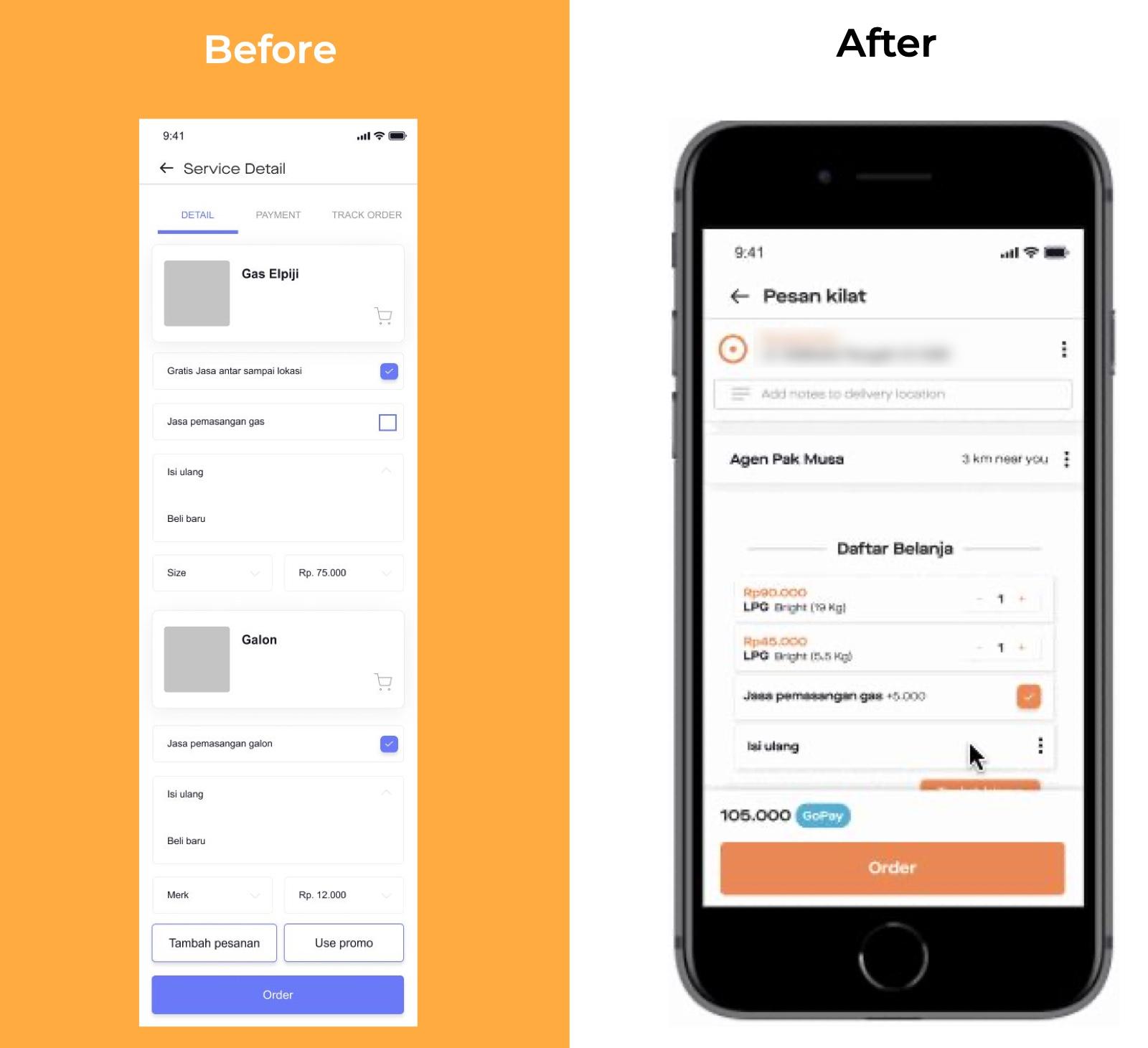
A study, not a shipped product.
Context
A study at Purwadhika's UI/UX Designer bootcamp, in 2020. Our team of four set out to revamp the design of the GO-Life app around one need: getting basic needs, like gas, drinking water and staples, from agents nearby. We called it GO-BAKO, from sembako, the Indonesian word for those basic needs. I was the team's UX strategist.
The people
Two kinds of user: buyers, and the agents who sell basic needs. We asked buyers where they live and how near the shops are, which basics they buy and how much, how they buy them, and what gets in the way.
The tension
We started from a hypothesis: people find it hard to get their basic needs. We tested it with in-depth interviews and a look at the apps that already existed, before designing anything.
Decisions
Two rounds of usability testing in February 2020 found the order flow too long and complex, so we replaced its accordions with an action sheet that keeps people on one step at a time. People could not add more items or check their order before paying, so we added a cart. And a repeat order took as long as the first, so we designed Instant Order, for ordering the usual without adding it again by hand.
Craft
Personas, an affinity map for each interview question, a customer experience map and a prioritization matrix; journeys two ways, starting from the product or from the agent; user flows over two sprints; then wireframes and lo-fi to hi-fi prototypes on the principles of Gojek's design system, Asphalt, checked with a heuristic evaluation.
Outcome
A hi-fi prototype with delivery and installation, Instant Order, and the agents nearby.
What it taught me
Usability tests and iteration are what make a solution fit the people it is for: a simpler flow, less information at once, and a friendly tone reached what they truly needed.